Reading time: 4 mins.
Content warning: Religious trauma.
“This church’s last potluck, and only two attendees.”
“We always said it’d come down to us.”
Judith raised her tea glass. “Cheers.”
“Cheers.” Susannah clinked her glass against Judith’s.
Only the moon through an ill-fitting window lit their repast. Turning on the lights in the Fellowship Hall would’ve risked tipping off the neighbors. Susannah had brought fried catfish and ambrosia fruit salad. Judith offered baked oysters in a crawfish sauce. The butter grits were only present in spirit.
“Sister Phoebe never let anybody fix the grits but her,” Susannah remarked.
Judith laughed. “Remember when she chased your dad out of the kitchen because he tried bring butter?”
Susannah had to hold her mouth closed with a napkin lest she lose an oyster. “It didn’t count as hers unless she’d bought all the ingredients herself.”
“I think enough time’s passed for us to admit how bland they were.”
“Amen to that. In a way that’s what I miss, though.” Susannah swallowed another oyster. “Nothing bland about these. I’d never have believed a man cooked them. Maybe you were meant to be a woman after all.”
Judith let sipping her tea mask her facial expression. She put the glass down a little harder than she meant to. “Whatever gets the point across.”
“Sorry, Judith.” Susannah looked away. “I’m actually very grateful you trusted me with that.”
Judith wiped her mouth and pulled a cloth-covered tray from her basket. “Then will you join me in another revelation?”
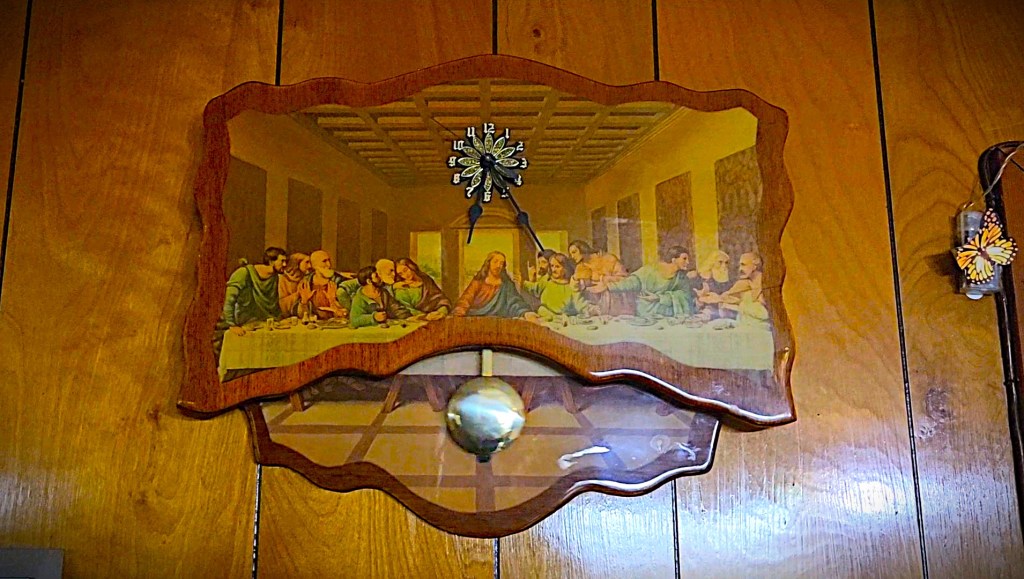
She pulled off the cloth to expose a dinner roll. “I couldn’t get the wafers we used in the old days, but this is King’s Hawaiian like Brother Otis brought towards the end.”
“The Eucharist?” Susannah asked.
“I didn’t stop being a mystic just because I became an atheist.”
Judith placed two disposable shot glasses and a bottle of grape juice on the table.
“Welch’s,” Susannah remarked. “What else?”
Judith’s wistful smile faded quickly.
“I’ve been thinking about how people lose their family’s faith. For some it just never held meaning, others find it violates their intellectual integrity.” Her voice became louder. “Or they realize their tradition only ever existed to prop up unjust power structures.” She reigned it back in. “Too many find themselves crushed by their own family’s heel.”
She held eye contact with Susannah.
“Some leave in spirit but feel trapped in body.”
She picked up the roll.
“How many people keep rehearsing this ritual Sunday after Sunday because they can’t tell their families what they really believe? How many still remember the wonder of believing that in this simple act they were touching God? What tears are shed mourning that easy rapture, and how many beautiful souls crucify their true selves again and again to re-enter that illusion?”
Her throa caught.
“How many die asking, ‘My God, My God, why have you forsaken me,’ because a lifetime’s reinforcement drowned the still, small voice of reason.”
Judith could feel the knives in the cutlery drawer watching her. She glanced at her wrists, half expecting to find oozing stigmata.
“Let us take this in remembrance of them.”
She tore the roll in half. “I break this bread like the body of our past must break so that we may have life in abundance.”
She extended one half to Susannah. “The body of whatever meaning you give it.”
Susannah accepted the bread with folded hands, after the manner she’d used in church all her life.
Judith filled the glasses. “As cousins we share the blood of our ancestors, with all its blessings and curses. Our heritage ultimately rests in our hands whether we accept or reject it. We decide where it goes, or doesn’t, from there. What was, was. What is, is. What will be belongs to us alone.”
She held out Susannah’s cup. “The blood of new covenants, thicker than the water of the womb.”
Susannah accepted the cup; they ate and drank together.
Judith crossed herself out of habit, deciding mid-motion to let the four points represent the four elements.
“And now may the peace of closure release us from harmful cycles and keep us in perpetual stability. Blessed be.”
“Amen,” Susannah whispered.
They finished their meals in silence.
“It’s good the old place finally closed,” Susannah said when they’d cleaned up, “no matter what our parents think. Hate that they have to watch it, but they’ll live. Maybe now so will we.”
“It still should’ve been the family’s choice,” Judith growled. “At least we know the Bishop won’t profit from selling the building.”
“Yeah.”
Susannah held up a gasoline can.
“Ready to light the candles?”

 Semi-Random Reflections
Leave a comment